



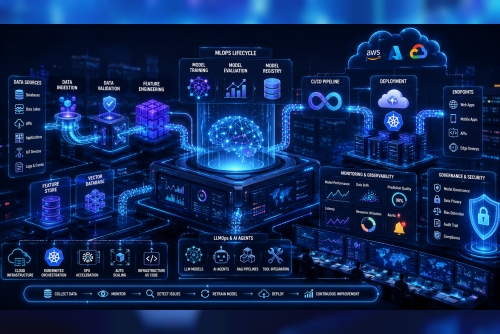
Artificial intelligence has moved well beyond experimentation. Organizations are no longer asking whether they should adopt AI—they're asking how to deploy, manage, monitor, and scale AI systems reliably. This shift has placed Machine Learning Operations (MLOps) at the center of enterprise AI strategies.
MLOps is a discipline that combines machine learning, DevOps, and data engineering to automate the complete lifecycle of machine learning models. From collecting data and training models to deployment, monitoring, governance, and continuous improvement, MLOps ensures that AI solutions remain accurate, secure, and production-ready.
As businesses rapidly embrace generative AI, AI agents, and predictive analytics, MLOps has become far more than a technical best practice. It has evolved into a business-critical capability that enables organizations to transform AI prototypes into scalable products delivering measurable value. Industry experts increasingly recognize that while AI models may grab headlines, operational excellence through MLOps is what determines long-term success.
Why MLOps Matters More Than Ever
Developing an accurate machine learning model is only one part of the AI journey. In production environments, models face changing customer behavior, evolving business conditions, new regulations, and shifting datasets. Without proper monitoring and maintenance, even highly accurate models gradually lose effectiveness.
MLOps addresses these challenges by introducing standardized workflows for data validation, automated testing, continuous integration, deployment pipelines, performance monitoring, version control, and retraining. These capabilities significantly reduce operational risk while improving collaboration between data scientists, software engineers, DevOps teams, and business stakeholders.
Organizations adopting mature MLOps practices often experience faster deployment cycles, improved model reliability, and greater confidence in enterprise AI initiatives.
The Rise of AI Agents Is Expanding the Role of MLOps
One of the biggest developments in 2026 is the rapid emergence of AI agents capable of planning, reasoning, and executing multi-step business tasks. Unlike traditional predictive models, these intelligent agents require continuous orchestration, memory management, governance, and real-time monitoring.
This evolution has expanded MLOps into adjacent disciplines such as LLMOps (Large Language Model Operations) and AgentOps, which focus specifically on operating foundation models and autonomous AI systems in production.
Rather than replacing traditional MLOps, these new operational layers build upon it. Organizations increasingly combine structured machine learning models with large language models, creating hybrid AI systems that require unified operational management.
Key Trends Shaping MLOps in 2026
1. AI Governance Takes Center Stage
As AI regulations expand across global markets, enterprises are prioritizing responsible AI practices. Modern MLOps platforms now include governance capabilities such as model lineage, explainability, bias detection, audit trails, and automated compliance reporting.
Governance is becoming a mandatory component rather than an optional feature, particularly in healthcare, banking, insurance, and government applications where AI decisions carry significant legal and ethical implications.
2. Real-Time Model Monitoring
Organizations can no longer rely on static machine learning models deployed months or years earlier.
Modern MLOps systems continuously monitor prediction quality, detect data drift, identify model degradation, and automatically trigger retraining pipelines when performance falls below predefined thresholds. This enables businesses to maintain consistent AI performance even as real-world conditions evolve.
3. Infrastructure Modernization
Recent industry surveys show that many enterprises possess ambitious AI strategies but lack the infrastructure necessary to support production-scale AI systems.
Cloud-native architectures, Kubernetes-based deployment, GPU optimization, feature stores, vector databases, and automated orchestration are becoming standard components of enterprise MLOps environments. Organizations are investing heavily in modern infrastructure to support increasingly complex AI workloads.
4. Responsible and Explainable AI
Businesses increasingly recognize that AI models must not only generate accurate predictions but also provide transparent explanations.
Explainable AI (XAI), fairness evaluation, bias detection, and ethical monitoring are now integrated directly into MLOps pipelines, allowing organizations to deploy trustworthy AI while satisfying regulatory expectations.
5. Hybrid AI Systems
Modern enterprises rarely rely on a single AI technology.
Instead, organizations combine predictive machine learning models, recommendation engines, computer vision, large language models, retrieval-augmented generation (RAG), and autonomous AI agents into unified business applications.
Managing these interconnected systems requires increasingly sophisticated MLOps platforms capable of orchestrating multiple AI components simultaneously.
Industries Accelerating MLOps Adoption
MLOps adoption continues to expand across nearly every major industry. Financial institutions use it for fraud detection, credit risk analysis, algorithmic trading, and compliance monitoring. Healthcare providers leverage MLOps for medical imaging, disease prediction, personalized treatment recommendations, and clinical decision support. Retail companies deploy machine learning models for demand forecasting, dynamic pricing, customer segmentation, recommendation engines, and inventory optimization. Manufacturing organizations rely on predictive maintenance, quality inspection, and production optimization powered by continuously monitored AI systems. Supply chain companies increasingly integrate AI into logistics planning, warehouse optimization, route scheduling, and operational resilience, with recent developments highlighting AI's growing impact on end-to-end supply chain transformation.
Popular MLOps Technologies
Today's MLOps ecosystem includes a broad range of specialized technologies supporting every stage of the machine learning lifecycle.
Commonly used solutions include:
MLflow for experiment tracking and model management
Kubeflow for Kubernetes-native ML workflows
Apache Airflow for workflow orchestration
Docker and Kubernetes for scalable deployment
TensorFlow Extended (TFX) for production ML pipelines
Amazon SageMaker, Azure Machine Learning, and Google Vertex AI for managed cloud MLOps
Databricks for collaborative data engineering and machine learning
Many enterprises also integrate Git-based version control, CI/CD pipelines, observability platforms, and automated testing frameworks into their MLOps environments to create fully automated AI delivery pipelines.
Challenges That Still Remain
Despite significant progress, implementing MLOps remains challenging. Organizations frequently struggle with fragmented data sources, inconsistent data quality, model reproducibility, infrastructure costs, security requirements, talent shortages, and cross-functional collaboration.
Another emerging challenge is balancing innovation with governance. As AI agents become more autonomous, businesses must establish clear operational boundaries, human oversight, accountability mechanisms, and continuous monitoring to ensure safe deployment.
The Future of MLOps
The next phase of MLOps extends beyond managing machine learning models—it focuses on operating complete AI ecosystems. Future MLOps platforms are expected to incorporate autonomous retraining, intelligent resource optimization, built-in governance, automated evaluation of large language models, multi-agent orchestration, and continuous business performance measurement.
Industry leaders increasingly emphasize that successful AI initiatives will depend less on building larger models and more on operating them efficiently throughout their lifecycle. Organizations that invest in mature MLOps capabilities today will be better positioned to scale AI responsibly, reduce operational risk, accelerate innovation, and deliver measurable business outcomes.
As enterprise AI continues to mature, MLOps is no longer simply an engineering discipline—it has become the operational backbone that transforms AI from isolated experiments into reliable, scalable, and business-critical systems capable of driving long-term competitive advantage.



