

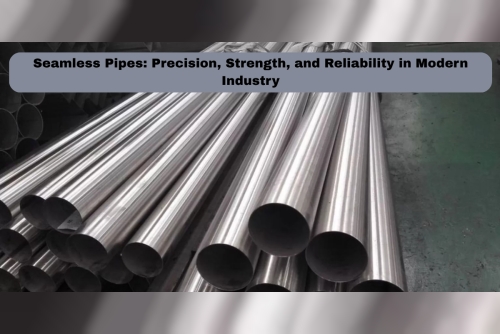
In industries where strength, durability, and precision are crucial, seamless pipes play an indispensable role. From oil and gas transmission to power generation and construction, these pipes form the backbone of critical infrastructure. Their unique manufacturing process and superior mechanical properties make them the preferred choice for high-pressure, high-temperature, and demanding applications.
What Are Seamless Pipes?Seamless pipes are cylindrical steel tubes without any welded seams or joints along their length. Unlike welded pipes, which are made by rolling and joining steel sheets, seamless pipes are manufactured from a solid round billet that is heated and then pierced to form a hollow tube.
This process ensures that the pipe’s structure is uniform and continuous, giving it greater strength, corrosion resistance, and ability to withstand internal pressure—qualities that make seamless pipes ideal for critical applications in energy, petrochemical, and engineering sectors.
Manufacturing ProcessThe production of seamless pipes involves a series of precise and high-temperature operations designed to achieve dimensional accuracy and mechanical strength. The most common manufacturing methods include:
Hot Rolling / Piercing:
A solid steel billet is heated to a high temperature and pierced using a mandrel or rotary piercer to create a hollow tube.
Elongation and Sizing:
The pierced billet is elongated using rolling mills to achieve the desired wall thickness and diameter.
Cold Drawing (Optional):
For tighter tolerances and smoother surface finishes, the hot-rolled pipe may undergo cold drawing, where it is pulled through dies at room temperature.
Heat Treatment:
The pipes are heat-treated to relieve internal stresses and enhance mechanical properties.
The result is a product with excellent dimensional precision, homogeneity, and strength, suitable for high-performance applications.
Materials and StandardsSeamless pipes can be manufactured from various materials, including carbon steel, alloy steel, stainless steel, and nickel alloys. The choice of material depends on the operating environment, such as pressure, temperature, and corrosion conditions.
Some of the common international standards governing seamless pipe production include:
ASTM A106 / A53 – Carbon steel pipes for high-temperature service
ASTM A312 – Stainless steel seamless pipes
EN 10216 – European standard for pressure purposes
API 5L – Seamless line pipes for oil and gas transportation
Key Properties of Seamless PipesSeamless pipes are known for their superior mechanical and physical characteristics, including:
High Strength and Pressure Resistance:
The absence of a welded seam eliminates weak points, allowing the pipe to handle higher internal and external pressures.
Uniformity and Structural Integrity:
With no joints or welds, seamless pipes offer uniform thickness and smooth internal surfaces for efficient flow.
Corrosion and Temperature Resistance:
Depending on the material, seamless pipes can withstand extreme temperatures and corrosive environments.
Dimensional Accuracy:
Especially in cold-drawn varieties, seamless pipes exhibit precise dimensions, which are crucial in precision engineering applications.
Longevity and Reliability:
Their robust design reduces maintenance and increases service life, even under harsh conditions.
Due to their unmatched strength and reliability, seamless pipes are used extensively in various industries, including:
Oil and Gas Industry:
Used in exploration, drilling, and transportation of oil and natural gas. Seamless pipes are ideal for high-pressure pipelines and refineries.
Power Generation:
Utilized in boiler tubes, superheaters, and heat exchangers due to their ability to withstand high temperatures and pressures.
Petrochemical and Chemical Plants:
Suitable for processing lines carrying corrosive fluids, acids, and gases.
Automotive and Mechanical Engineering:
Used in manufacturing hydraulic systems, bearing shells, and precision mechanical components.
Construction and Infrastructure:
Applied in structural supports, columns, and piping systems where strength and safety are critical.
Shipbuilding and Aerospace:
Lightweight and high-strength seamless pipes are used for fuel lines and high-performance applications.
No Welded Seams: Eliminates potential weak points and risk of leakage.
Superior Strength: Can handle higher mechanical stress and pressure.
Smooth Internal Surface: Ensures uninterrupted flow of fluids and gases.
Corrosion Resistance: Enhanced durability in harsh environments.
Wide Range of Sizes: Available in varying diameters and wall thicknesses to meet industry requirements.
Longer Service Life: Reduced maintenance and replacement costs over time.
Conclusion
In summary, seamless pipes stand as a symbol of precision engineering and durability. Their unique manufacturing process eliminates weld seams, ensuring superior mechanical strength and flawless performance under extreme conditions. From the oil fields to industrial plants, these pipes form the arteries of modern infrastructure—delivering fluids, gases, and energy efficiently and safely. As industries continue to evolve, seamless pipes will remain a cornerstone material, enabling innovation, safety, and sustainability in engineering worldwide.