


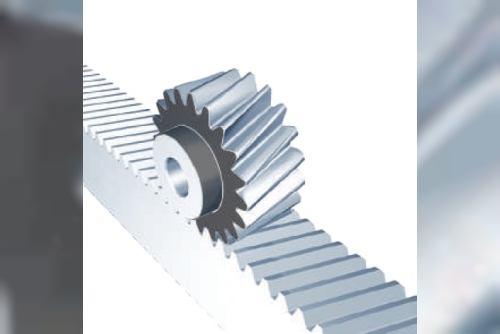
In modern industrial engineering, high-precision motion systems require stable force transfer and efficient structural design, especially when using Helical Rack mechanisms to convert rotational motion into controlled linear movement with improved smoothness and reduced vibration in continuous operation environments. This structure is widely applied in automation equipment, robotics systems, and CNC machinery where accuracy and reliability are essential for production quality.
Material engineering plays a crucial role in determining system durability. High-strength alloy steels are commonly selected due to their ability to resist fatigue, wear, and deformation under repeated mechanical stress. Heat treatment improves hardness while maintaining internal toughness, ensuring long-term stability even under high-load conditions. Surface enhancement techniques further reduce friction and improve operational efficiency.
The functional advantage of this system lies in its gradual tooth engagement, which distributes force more evenly across contact surfaces. This reduces impact stress and enhances motion stability. Engineers focus on optimizing geometric alignment to ensure smooth transmission and minimize backlash, improving overall system performance in dynamic industrial environments.
Thermal stability is another key factor in long-term operation. Continuous movement generates heat that may affect dimensional precision if not properly managed. Advanced lubrication systems and thermally stable materials help maintain consistent performance under varying temperature conditions, ensuring reliable operation during extended production cycles.
Vibration control is also essential in high-speed systems. The helical structure naturally reduces sudden impact forces, leading to quieter operation and improved mechanical lifespan. Computational analysis is often used to simulate stress distribution and refine design parameters before manufacturing, improving reliability and reducing failure risk.
Modern industrial systems also require modular adaptability, allowing components to be integrated into different machine architectures. This flexibility improves scalability and reduces maintenance complexity, making systems more efficient in large-scale production environments.
Zhejiang Yuchen Transmission Technology Co., Ltd. contributes to this field by developing precision transmission components designed for demanding industrial applications. Their engineering focus supports industries requiring stable, high-performance motion systems capable of long-term operation under complex conditions.
Digital monitoring technologies further enhance system reliability. Sensors embedded in mechanical systems track vibration, temperature, and load in real time, enabling predictive maintenance strategies that reduce downtime and extend equipment lifespan.
The second occurrence of Helical Rack highlights its continued importance in achieving efficient and precise motion control in advanced industrial systems. For further engineering solutions, detailed product resources are available at https://www.yc-rack.com/product/spur-gear-rack/ where modern transmission technologies continue to evolve for industrial use.